Should You Use the Same Keyword in Broad, Phrase, and Exact Amazon Sponsored Products Campaigns?

Amazon advertisers often copy one keyword into broad, phrase, and exact match because each option is available. The difficult question is whether that creates useful control or spreads the same budget across overlapping eligibility.
For brands working with an Amazon Ads Verified Partner Agency, match-type structure should be based on the keyword’s role, available data, and the account’s budget rather than a one-size-fits-all campaign template.
The answer depends on the keyword’s job, the available data, and whether bids and negatives are designed to keep discovery separate from control.
The Direct Answer
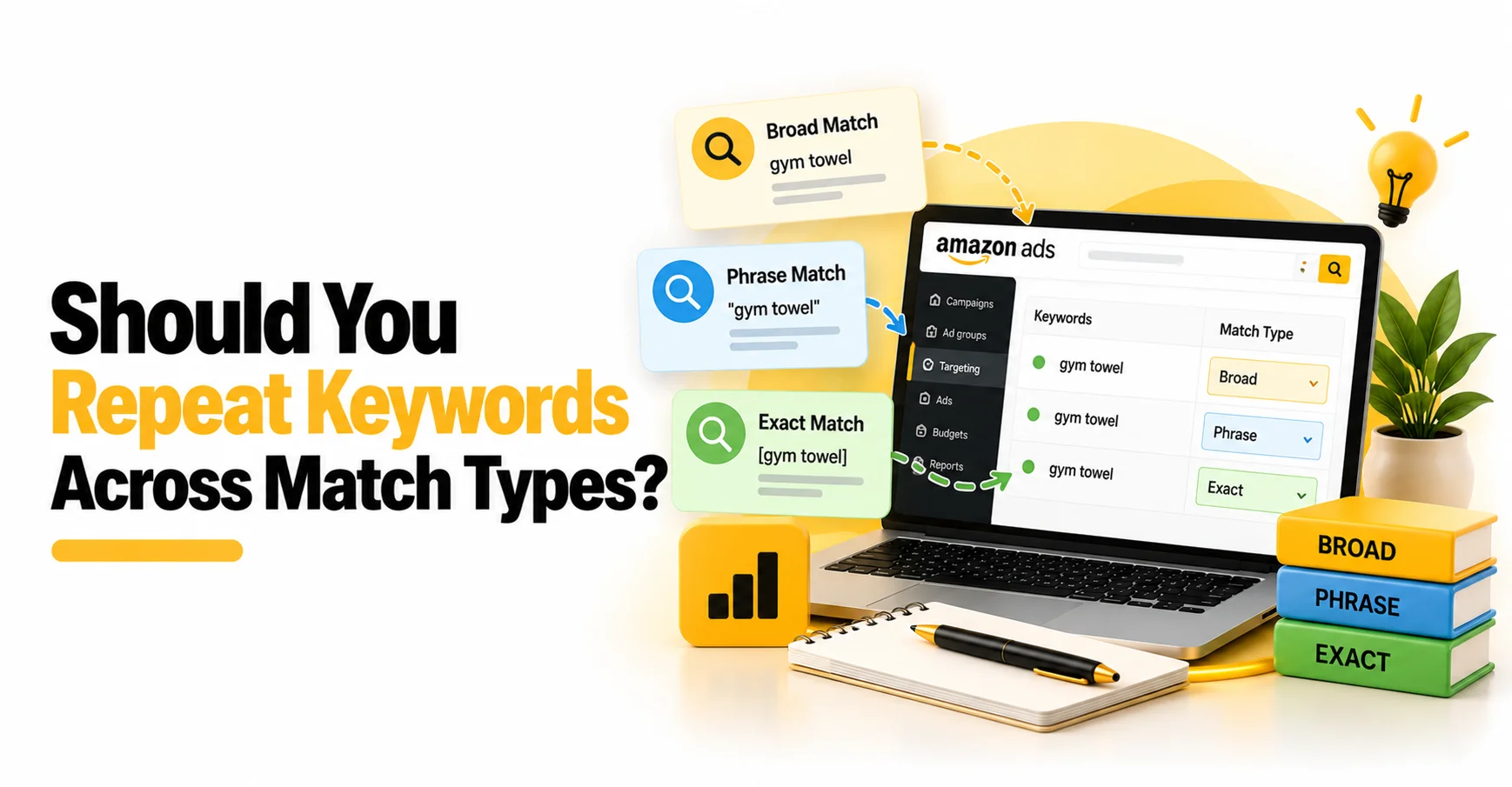
Yes but not by default. Use the same keyword in broad, phrase, and exact Sponsored Products targeting only when each match type has a defined role and a different bid. Broad should discover relevant queries, phrase should test controlled extensions, and exact should manage a proven query more deliberately.
Amazon Ads match-type documentation states that broad, phrase, and exact all account for plurals, misspellings, and translations. It also states that when multiple match types with different bids use the same keyword, the highest bid is used for a matching shopping query. Exact is therefore not automatically preferred simply because it is more restrictive.
Amazon Ads keyword-targeting guidance recommends different bids when using multiple match types for the same keyword and reviewing performance after the campaign has run for two weeks. Treat three-match-type coverage as a controlled test, not a default template for every keyword.
When the Answer Changes
- Brand-new account with no search-term history: Test all three match types selectively on priority keywords, using distinct bids rather than cloning the entire keyword list.
- Proven converting query: Let exact carry the primary control role; keep phrase or broad only when they continue producing useful additional search terms.
- Limited daily budget: Prioritize exact and carefully chosen phrase keywords; broad can be smaller, isolated, or paused until the account can fund discovery.
- Low-volume keyword: Use fewer match types until enough traffic exists to justify separation.
- Exact query already isolated from discovery: Consider negative exact in the broader campaign after validating the destination campaign, bid, budget, and advertised products.
- Different products or margins: Separate match-type decisions by product economics instead of forcing one structure across the catalogue.
Practical Diagnostic Checklist
- Confirm that the keyword is relevant to the advertised product and listing content.
- Pull the search-term and targeting reports for a consistent review period.
- Record the keyword’s broad, phrase, and exact bids in one view.
- Compare spend, sales, orders, ACoS, ROAS, click-through rate, and conversion rate by match type.
- Identify which customer queries each match type actually matched.
- Label every keyword as discovery, validation, or control.
- Check whether the same precise query is being served from multiple campaigns or ad groups.
- Confirm that the intended exact campaign has enough bid and budget before adding a negative exact elsewhere.
- Allow for the platform’s stated processing time before judging a newly added negative.
- Reassess match-type structure after at least two weeks unless spend or relevance makes earlier intervention necessary.
Anonymized Account Example
In a supplied US accessories-account plan, three product portfolios were separated, the daily advertising budget moved from $270 to $300, targets with more than 90 days of activity and no sale were flagged for hygiene action, and bids on spend-without-sale targets were marked for a 20% reduction.
Proven targets used staged bid increases of 5%, 8%, and 10% after reaching 5+, 10+, and 20+ orders. Match-type-level results were not supplied, so this is not a performance claim. The evidence shows why bid logic should follow the target’s job and order history rather than be copied across broad, phrase, and exact.
Decision Table
| Scenario | Recommended structure | Why |
|---|---|---|
| New account, no history | Test selected priority keywords in broad, phrase, and exact with different bids | Builds discovery and control without cloning the full list |
| Proven converting query | Let exact carry the main control bid; retain broader types only if they add useful terms | Protects control while preserving expansion |
| Limited daily budget | Start with exact and selective phrase; keep broad smaller or paused | Concentrates spend where intent is clearer |
| Exact query isolated | Add negative exact to the broader campaign after validating the destination | Reduces overlap for that precise query |
| Low-volume keyword | Use fewer match types until traffic justifies separation | Avoids fragmenting sparse data |
Mistakes Genuinely Observed by I.E.RARE
The following patterns are limited to issues documented in supplied PPC review work:
- Using the same keyword in broad, phrase, and exact without assigning a distinct purpose or bid to each match type.
- Leaving targets active after more than 90 days without sales instead of reviewing relevance, click volume, product lifecycle, and strategic value.
- Applying one blanket bid change instead of separating spend-without-sale targets from targets with verified order volume.
- Adding negatives before confirming that the intended destination campaign can win traffic and remain in budget.
Recommended Action
- Start with a role map: broad for discovery, phrase for controlled expansion, and exact for proven-query control.
- Use different bids for the same keyword across match types; do not assume exact will win automatically.
- Begin with a limited set of priority keywords instead of duplicating the full research list three times.
- Promote a validated search term into exact when it has enough evidence for deliberate control.
- Use negative exact in discovery campaigns only after confirming the exact destination is active, sufficiently funded, and product-aligned.
- Review search-term results and revise bids, negatives, and match-type coverage as evidence develops.
Amazon Ads negative-targeting guidance says negative keywords can use phrase or exact match and that negative keywords may take up to 72 hours to take effect. Do not judge routing immediately after the change.
Frequently Asked Questions
Does using the same keyword in all three match types make campaigns compete against themselves?
Overlapping match types can be eligible for the same shopping query. Amazon states that when the same keyword has multiple match types with different bids, the highest bid is used for a matching query. The practical problem is usually weak control and unclear reporting, not a reason to avoid every overlap.
Should exact match always have the highest bid?
No universal bid order fits every account. Exact often receives the strongest bid when it represents a proven, profitable query, but margins, placement performance, budget, conversion, and business goals still govern the decision.
Should a new Amazon account launch broad, phrase, and exact together?
It can test all three on selected priority keywords with different bids. A new account should not automatically copy every keyword into every match type when its budget and data are limited.
When should a search term be moved to exact match?
Move it when the term is relevant and has enough clicks, orders, conversions, and cost evidence to justify direct control. The evidence threshold should reflect price, margin, traffic volume, and the account’s acceptable ACoS.
Should the broader campaign receive a negative exact immediately?
Only after the exact destination is live, correctly targeted, adequately funded, and able to serve the intended products. Otherwise, the negative may remove traffic without creating reliable replacement coverage.
Related I.E.RARE Services
IERARE’s Amazon Sponsored Ads Management service helps Amazon sellers separate discovery from control, structure match types, review search terms, manage negatives, and align bids and budgets with product-level performance.
As an Amazon Ads Verified Partner Agency, IERARE can also support broader Amazon advertising strategy alongside account management, listing optimization, and marketplace operations.
For brands running paid campaigns beyond Amazon, IERARE also provides Social Media Ads Management to help manage paid social campaigns across relevant platforms.
Contact Us
If your Amazon PPC campaigns have overlapping match types, unclear keyword routing, wasted spend, or inconsistent performance, Contact Us to discuss your campaign structure and identify the right optimization approach.
Author Bio
The I.E.RARE Team works across Amazon Sponsored Ads, account management, listing operations, ecommerce SEO, creative production, and conversion optimization. Its content focuses on practical decisions grounded in account evidence and current platform guidance.