Why Amazon Account Health Warnings Cannot Be Fixed by PPC Changes

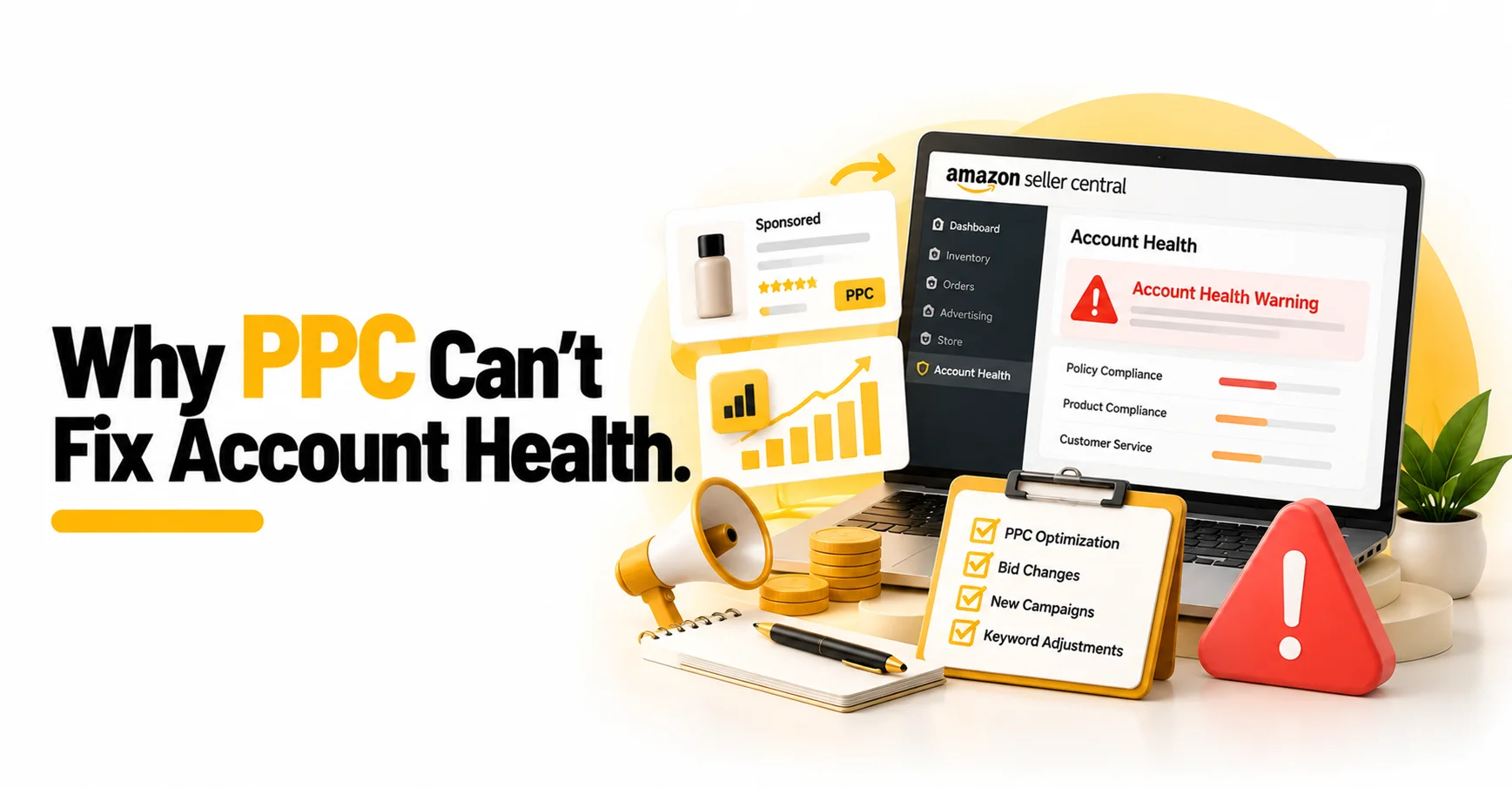
When an Amazon seller sees falling sales or unstable advertising performance, the first instinct is often to change bids, budgets, or targeting. That response can miss the real constraint when Seller Central is showing verification, policy, listing, or order-performance warnings. An experienced Amazon marketing agency looks beyond campaign metrics to identify whether the account itself, product availability, or fulfillment operations are limiting growth.
The Direct Answer
PPC changes cannot resolve a business-information certification request, policy-compliance violation, seller-fulfilled cancellation problem, suppressed offer, or account-level enforcement risk. Resolve the account and operational cause first. Optimize advertising after the affected offers are compliant, buyable, and realistically fulfillable.
Amazon’s Seller dashboard guide directs sellers to the Account Health dashboard for customer-service, shipping-performance, and policy-compliance signals. Amazon’s cancellation-rate policy separately defines cancellation rate across a seven-day period for seller-fulfilled orders and recommends keeping it below 2.5%. Amazon’s INFORM Consumers Act guidance says covered high-volume third-party sellers in the US store must keep specified business information current and certify it at least annually; sellers should follow the response timeline in the notice.
When the Answer Changes
- If Account Health is clear, the listings are buyable, inventory is available, and the only deterioration is in traffic cost or targeting quality, Amazon PPC Management Services can be the first workstream.
- If a warning affects one listing rather than the whole account, isolate that offer while protecting compliant, in-stock products from unnecessary disruption.
- If Amazon provides a verification or certification deadline, follow the exact notice and complete the requested information before broader growth work.
- If the cancellation signal comes from inventory, handling-time, or order-confirmation failures, operations and catalog availability take priority over campaign scaling.
- If an issue is already under appeal, preserve case references and evidence before changing related listings or account information.
Practical Diagnostic Checklist
- Open Account Health and record each active alert, affected marketplace, deadline, and available action.
- Separate business verification, policy compliance, listing restrictions, intellectual-property or product-safety issues, and order-performance signals.
- Check whether the problem affects the full account, a fulfillment method, a product category, or a specific offer.
- Download the cancellation report and reconcile seller-canceled orders with stock levels, handling times, and shipment confirmations.
- Confirm that advertised offers remain active, buyable, in stock, correctly priced, and eligible for the expected placement.
- Stop preventable demand generation only where the offer cannot be fulfilled or the listing is not eligible to sell.
- Keep copies of notices, submitted documents, case references, appeal text, and status changes.
- Review PPC structure only after the account-health and fulfillment constraints are understood.
Anonymized Account Example
A verified I.E.RARE account review showed a request to review and certify business information with a stated risk of deactivation, 72 policy-compliance issues, and a 32.26% pre-fulfillment cancellation rate in the most recent seven-day snapshot.
Those signals were not advertising problems. The required diagnosis was verification, compliance triage, and order-operations investigation before PPC optimization could address growth. No post-remediation performance result was supplied, so none is claimed.
Decision Table
| Signal or warning | What it controls | First action |
|---|---|---|
| Business-information certification request | Selling-account verification | Complete the requested certification by the stated deadline |
| Policy-compliance issues | Listing or account policy status | Group by issue type and resolve the highest-risk items |
| High pre-fulfillment cancellation rate | Seller-fulfilled order performance | Reconcile stock, handling time, and shipment confirmation |
| Advertising metrics only; account health clear | Traffic efficiency | Optimize targeting, bids, budgets, and placements |
Mistakes Genuinely Observed by I.E.RARE
- Opening the advertising console first when an account-level warning is active.
- Treating dozens of policy issues as one task instead of grouping them by type, severity, affected offer, and deadline.
- Increasing demand while seller-fulfilled cancellation data points to an inventory or order-processing problem.
- Using ROAS as proof that the selling account is healthy, even though advertising efficiency and account eligibility are separate controls.
- Changing listings or account information without preserving the original notice, evidence, case reference, and submission date.
Recommended Action
- Start with any business-information request or account-level deactivation warning and follow the exact instructions in Seller Central.
- Triage policy issues by enforcement risk, deadline, customer impact, and number of affected offers.
- Investigate seller-fulfilled cancellations using the downloadable report; correct stock, handling-time, and order-confirmation causes.
- Confirm that the remaining advertised offers are compliant, active, in stock, buyable, and fulfillable.
- Only then adjust bids, budgets, targeting, placements, and campaign structure using clean performance data.
Frequently Asked Questions
Can PPC changes remove an Amazon account-health warning?
No. Advertising settings do not complete verification, resolve policy violations, reinstate restricted offers, or fix order-performance causes. Use the workflow specified in Account Health or the relevant performance notification.
Should every ad campaign be paused after a warning?
Not automatically. Pause or limit promotion for affected, unavailable, or unfulfillable offers. Keep healthy campaigns running when their offers remain compliant, buyable, in stock, and operationally supportable.
What should be fixed first when the account shows many issues?
Prioritize time-bound verification requests and account-level enforcement risk, then issue severity, customer impact, offer eligibility, and operational causes. The raw count alone does not determine the correct order.
Why does cancellation rate matter before PPC optimization?
A campaign can generate more orders, but it cannot create inventory or repair fulfillment processes. Amazon states that cancellation rate applies to seller-fulfilled orders and that a rate above 2.5% may result in deactivation of seller-fulfilled offers.
When should advertising scale resume?
Resume or expand only after the account status is understood, affected offers are eligible and buyable, inventory is reliable, and the team can fulfill the demand being purchased.
Related I.E.RARE Services
IERARE provides Amazon Account Management Services covering account monitoring, inventory coordination, case-log management, listing operations, customer support, and advertising as connected workstreams.
For brands that need campaign strategy and optimization, our Amazon PPC Management Services can address bids, budgets, targeting, placements, search terms, and campaign structure once account-health and fulfillment issues are under control.
If listing quality is contributing to poor conversion or advertising efficiency, Amazon Product Listing Services can help improve titles, bullets, descriptions, keywords, and other relevant listing elements.
For businesses managing broader paid advertising beyond Amazon, Paid Search Management Services can support search-focused campaigns across other advertising platforms.
Contact Us
If your Amazon account is facing policy warnings, fulfillment issues, listing restrictions, or unstable advertising performance, Contact Us to discuss the account and identify the appropriate next steps before increasing ad spend.
Author Bio
The I.E.RARE Team works across Amazon account management, Sponsored Ads, listing operations, ecommerce SEO, creative production, and conversion optimization. Our content focuses on practical decisions grounded in account evidence and current platform guidance.